Eucharistic Christ Our Light
The Real Presence. The Light of Christ. The Gift of Grace.
“I am the light of the world.” — John 8:12
The Mystery Behind the Artwork
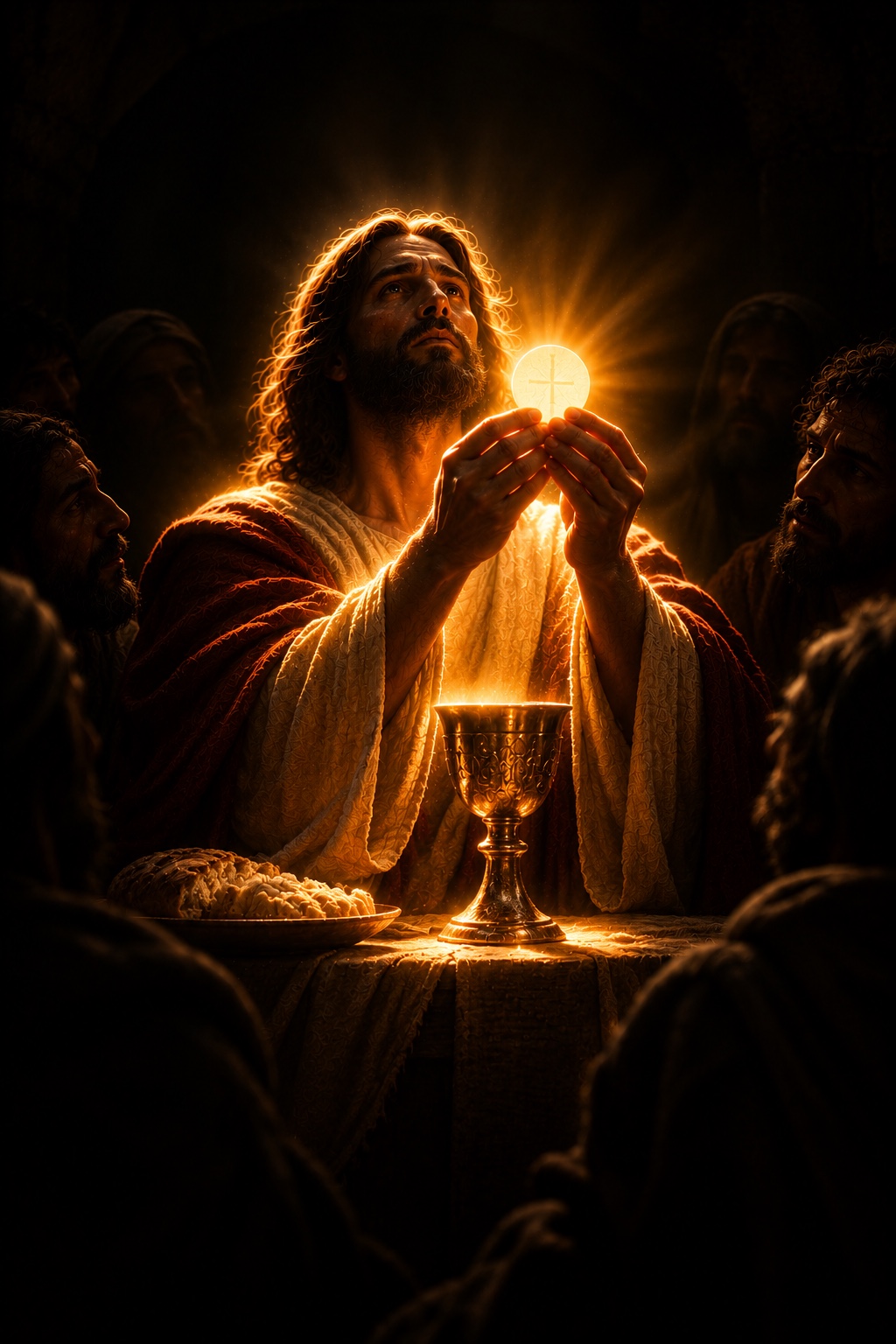
At the center of Eucharistic Christ Our Light stands Jesus Christ, holding the radiant Eucharistic host above the chalice.
Surrounded by darkness, Christ illuminates everything around Him.
The imagery expresses a profound truth of the Catholic faith: Jesus Christ is not distant from His people. He remains with His Church, giving Himself to us in the Most Holy Eucharist.
At the Last Supper, Jesus took bread, blessed it, and declared:
“Take and eat; this is my body.” — Matthew 26:26
He likewise identified the chalice with His Blood of the Covenant, poured out for the forgiveness of sins (Matthew 26:27–28).
The Catholic Church has faithfully preserved this teaching throughout the centuries.
In the Holy Eucharist, Christ is truly, really, and substantially present—Body, Blood, Soul, and Divinity.
The Mass makes sacramentally present the one sacrifice of Christ, and the faithful are invited to receive Him worthily in Holy Communion.
The Catechism of the Catholic Church calls the Eucharist the source and summit of the Christian life (CCC 1324).
A Mystery Beyond Time
Consider the extraordinary mystery of the Last Supper.
Jesus Christ, the eternal Son of God who entered human history through the Incarnation, sat bodily among His apostles. His Passion, Crucifixion, and Resurrection had not yet occurred.
And yet, while visibly present before them in His human body, He offered them His very Body and Blood in the Holy Eucharist.
The apostles encountered the same Lord in two distinct ways: visibly, in His living human body, and sacramentally, under the appearances of bread and wine.
How extraordinary that the eternal Son of God, who is not limited by time as we are, could institute this sacrament before His sacrifice on Calvary!
The Last Supper anticipated His Passion, and every Holy Mass makes sacramentally present that same sacrifice, offered once for all upon the Cross.
Christ is not sacrificed again at each Mass. Rather, through the mystery of the Eucharist, the Church participates in His one eternal offering.
This mystery reminds us that God's saving work transcends the limitations of our ordinary human understanding.
Why the Artwork Depicts the Eucharistic Host
At the Last Supper, Jesus would not have held the familiar round, white Communion host used in the Latin Church today. In the Jewish Passover setting described by the Gospels, the bread would have been unleavened bread.
The artwork deliberately depicts the Eucharistic host as Catholics recognize it today.
This artistic choice connects the historical institution of the Eucharist with our own encounter with Christ in the Blessed Sacrament.
The Christ who offered Himself to the apostles at the Last Supper is the very same Christ whom we adore and receive in the Holy Eucharist today.
The image invites us to look beyond the appearances of bread and recognize, through faith, the Lord who gives Himself to us.
This is the mystery that inspired the artwork. The golden light represents Christ Himself, illuminating the darkness of the world and inviting souls into communion with Him.
An Artist's Reflection
My Journey Toward Surrender
My journey into the Catholic Church was not an easy one.
Raised Methodist, I spent much of my life studying Scripture, searching for religious truth, and moving among different Christian denominations.
When I married my Catholic wife, I initially attended Catholic instruction intending to demonstrate the errors I believed existed within the Church.
Instead, my investigations into Scripture, the early Church Fathers, and Catholic teaching eventually led me to recognize the fullness of Christian truth in the Catholic Church.
Yet recognizing that truth and submitting myself to it were two different things.
For years, I struggled with teachings I did not fully understand or willingly accept.
Interestingly, the Eucharist was never one of those difficulties.
Christ said that the bread was His Body and that His followers must eat His Flesh and drink His Blood. I believed Him.
The Eucharist: Christ's Own Words
In the sixth chapter of St. John's Gospel, Jesus teaches something extraordinary.
He identifies Himself as the Bread of Life and declares that His Flesh is true food and His Blood true drink.
He goes even further, warning that unless we eat the Flesh of the Son of Man and drink His Blood, we do not have life within us (John 6:53–56).
Many of His disciples found this teaching so difficult that they protested against it.
They called it a hard teaching, and many abandoned Him.
What struck me was Christ's response.
Jesus did not call them back to explain that He was speaking merely symbolically. He did not soften His teaching to make it more acceptable.
He allowed them to depart.
Then He turned to the Twelve and asked whether they, too, wished to leave.
Peter responded by professing his faith in Christ, whose words are the words of eternal life (John 6:60–69).
For me, this passage powerfully supports the Catholic understanding of the Eucharist.
Christ's words were not simply an invitation to remember Him through an ordinary symbolic meal. They revealed a profound mystery that requires faith.
At the Last Supper, Jesus instituted the Eucharist, giving His Body and Blood under the appearances of bread and wine.
The Church's teaching on the Real Presence is not an attempt to add something to Christ's words. It is a faithful reception of what He revealed.
A Gift That Demands Reverence
Sacred Scripture also warns us that receiving the Eucharist is not something to approach casually.
In 1 Corinthians 11:27–29, St. Paul warns that those who receive the Body and Blood of the Lord unworthily, without proper examination and discernment, bring judgment upon themselves.
Some older English translations use the word damnation.
This warning is extremely serious, but the word translated as judgment does not necessarily mean eternal damnation. Paul also speaks of God's corrective discipline so that we may not be condemned with the world (1 Corinthians 11:32).
The Catholic Church therefore teaches that anyone conscious of grave sin must ordinarily receive the Sacrament of Reconciliation before receiving Holy Communion (CCC 1385).
The Eucharist strengthens us against sin and deepens our communion with Christ. It is not, however, a substitute for sacramental confession when we are conscious of mortal sin.
These teachings helped me understand both the extraordinary gift of the Eucharist and the reverence with which we must receive our Lord.
Discovering My Need for Grace
My greater struggle was recognizing what that belief required of me.
Eventually, I came to understand that I could not overcome my own sinful inclinations through determination alone.
I needed God's grace.
I needed to stop attempting to save and sanctify myself through my own efforts and humbly surrender to the transforming work of Jesus Christ.
Through sacramental confession, prayer, Eucharistic adoration, and increasingly faithful participation in the Holy Mass, I began to experience a profound transformation in my spiritual life.
I discovered that the Eucharist was not merely a doctrine to defend.
The Eucharist is Christ Himself, whom I desperately needed.
I came to recognize that the light capable of overcoming the darkness within me was not my own.
It was His.
And that realization helped inspire Eucharistic Christ Our Light.
The Light That Transforms
The image portrays Christ holding the Eucharist as brilliant light radiates into the surrounding darkness.
For me, that light represents more than spiritual enlightenment.
It represents the grace of Jesus Christ, who calls sinners to repentance, forgives those who seek His mercy, and strengthens His people to pursue holiness.
The artwork is intended to invite contemplation of the Real Presence and encourage a deeper appreciation of the Holy Eucharist.
It also reminds us that Christ's light is meant to be shared, freely and with a profound love.
In Matthew 5:14–16, Jesus calls His disciples to let their light shine before others so that their good works may glorify the Father.
We are not the source of that light.
Christ is our Light. Our calling is to reflect Him.
Sacred Art in Service of Evangelization
Eucharistic Christ Our Light is more than a digital composition.
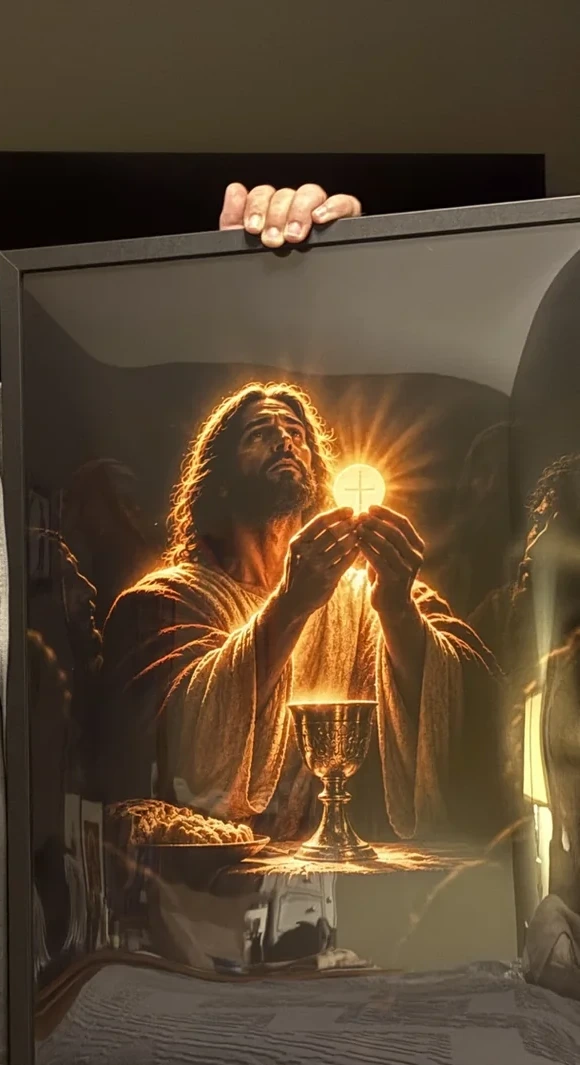
The artwork has been produced as large-format framed sacred art and shared through charitable outreach.
It is also being used in Catholic devotional and catechetical presentations in the St. Louis region and beyond.
These opportunities reflect the purpose behind Sacred AiRTworks: to create beautiful, theologically faithful imagery that helps people contemplate the mysteries of the Catholic faith.
The artwork is not a substitute for the Holy Eucharist, the Mass, or prayer before the Blessed Sacrament.
Rather, it is intended to direct our attention toward Christ and inspire a desire to encounter Him more deeply in the sacramental life of the Church.
A Gift to Share
Free Download — Eucharistic Christ Our Light
In keeping with the charitable mission of Sacred AiRTworks, we are making Eucharistic Christ Our Light available as a free digital download.
Our hope is that this image will find its way into homes, classrooms, parish programs, prayer gatherings, and Catholic evangelization efforts.
May it encourage contemplation of the Eucharistic mystery, strengthen devotion to the Blessed Sacrament, and inspire others to seek the light of Jesus Christ.
Download Eucharistic Christ Our Light — FREE
Available through our Free Downloads collection. No purchase or account required.
Go to free download ↓A Prayerful Hope
May those who encounter this image be reminded that no darkness is greater than the light of Jesus Christ.
May they discover His mercy through repentance and reconciliation, His presence in the Most Holy Eucharist, and His transforming grace throughout their lives.
And may all that we create and share ultimately lead souls closer to Him.
Ad Majorem Dei Gloriam — For the Greater Glory of God.
Catholic teaching references: Catechism of the Catholic Church, paragraphs 1324, 1337–1340, 1362–1367, 1374, 1385, 1393–1395, 1415, and 1418.
Scriptural references: Matthew 5:14–16; Matthew 26:26–28; Luke 22:7–20; John 6:51–69; John 8:12; 1 Corinthians 11:23–32.